Sunday, 22 September 2013

John Virtue

John Virtue is a landscape artist who usually works in monochrome. He likes working with Black ink straight onto blank canvases as he likes the bold black marks it creates. His subject matter is usually the landscape of where ever he is living and after living in rural devon creating abstract paintings he was then approached by the national gallery in london where he took up a new expressive but not abstract way of working. I like the way John starts by looking at the landscape of the city and in his sketch book just marking the shapes and lines he can see showing the background as well as the foreground. He then takes these sketches back to his workshop where he works from these to create large scale, at first just silhouettes of london. I like how he goes straight in with the ink and if he makes a mistake he just works over the top. He builds his paintings up in layers starting with just loosely painting the main shapes of the city using ink. In his documentary he says that at this point it all looks wrong, so he works into the background using white acrylic. He likes using Jade cloths or his hands to paint with to mould it into the canvas. This allows him to model the forms he first created with ink. I love the contrast between the white acrylic and the black ink and how the acrylic softens the black lines. He then creates different textures using sprays and buckets of ink to create the gloom above london which John says represents all the carbon monoxide and pollution in the air.  I like how he creates an atmosphere in his paintings by using different techniques of spreading the ink across his canvas. But his main concern is the position and composition of his work.

Preparatory drawing by John Virtue.
John Virtues sketch book- creating basic lines and shapes to work from.

Famous Painters: John Virtue Painting
 John Virtues Black ink and white acrylic on canvas.


Link to documentary - here

Thorsten Brinkman

Thorsten Brinkman creates portrait photography based an old style of art and painting from the 1800s. I like his work as he creates a familiar image and composition which you can recognise from old mastery paintings, yet at a closer look it is made up of Brinkmann's strange collection of objects. 


This is my favourite piece of Brinkmans work as i like how the composition is one that is very recognisable from the old mastery style of work. The composition is different to the rest of his photography as most of them are central portraits. 

Thorsten Brinkman always photographs himself but I like how you can never see his face. The absence of his face makes the character he's creating, mysterious and strange. This draws me into his work, curious about the artist underneath the layers of costume. 

Thursday, 19 September 2013

Photogaphy lesson 1

T-Shirt sculpture inspired by Erwin Wurm
During our first Photography lesson we used inspiration and ideas from artists such as Erwin Wurm and Thorsten Brinkmann who create sculptures and photography using the human form. We started by creating a one minute sculpture using a large T-shirt. This exercise got us to think of the t-shirt not as a conventional t-shirt but just a piece of material, we then had to create different, interesting ways of wearing it.


We then had to do the same but with a partner, this allowed us to create more interesting shapes as we had two bodies to work with. We decided to lean away from each other making the material tighter and therefore revealing the shapes and curves of the human form. I think this creates an interesting photo. Whilst editing the image i decided that by lowering the saturation creating a black and white image, it allowed you to focus more on the lines and shapes the sculpture holds rather then being distracted by the bright colours.


This was another sculpture /Photograph we created as a pair. This idea came from the image of someone struggling to take their T-Shirt off. We both got in recognisable positions people find themselves in whilst getting changed. I liked the idea of creating something that people can relate to.


Our final exercise was to create a piece based on Thorsten Brinkmann's work. We were given a range of materials and objects to create a character to photograph. I decided to cover my models face to make her mysterious and eery. I find the less you can see the more intriguing something is, drawing the viewer in making them want to discover more. I gave her a stick to give her authority and power.

Eadweard Muybridge


Eadweard Muybridge was a photographer known for his photographic studies of motion and in motion-picture projection. He was most well known for his peice 'the horse in motion'. This was such a well known piece of work as people discovered that when a horse is running there is a point where all its legs are off the ground. I like how Muybridge's work makes time visible allowing you to see something in motion part by part and the shapes it forms.


I am mainly interested in Muybridges studies of dance, my favourite piece being 'Woman Dancing (Fancy)'. I love how in this series of photographs he has used the white dress flowing to create shapes and show the her movement.

'Woman dancing (fancy)'

Lewis Hine

Lewis Hine was an American sociologist and photographer. Hine used his photography as a tool to campaign for social reform. I especially like his child labor series. I like how he captures expression in his portrait photography, in this series pain and hopelessness.

This Photo draws you in as the child is looking straight at you as if asking for help. I like how although Hine's photography shows the children looking pessimistic, he gave the them hope that things would change. 


Alexander Calder

Alexander Calder was an American sculptor known best as the creator of the mobile (A kinetic sculpture, balanced or suspended, which moves in response to air currents.) I was mainly interested in Calder's wire figures. I like his experimental way of three dimensional drawing as it allowed Calder to draw loosely and freely, not thinking about detail but the shapes that make up a face or the object he was drawing. I also like the freedom wire gives you to change your lines.


I especially like the piece above as i like how the figures overlap and look like they are both gazing up to the same point- in this photograph, at the artist. I think Calder's wire figures have real character and expression, some very humorous (the sculpture below).

'Dove real beauty sketches'

During our lesson we experimented with drawing using different techniques we weren't as comfortable with, for example drawing with our wrong hand or drawing from what we could feel without seeing it. I enjoyed this exercise as it allowed me to think more about textures and detail rather then the object as a whole. Although the outcome didn't necessarily look like what i was drawing, i discovered textures i wouldn't of found if i was looking at the object.
Drawing my own face with my eyes closed,  feeling for texture. Oil Pastils. 5 minute sketches overlapped.


Given an object whilst my eyes were closed (a shell).  Drawing the textures and shapes i could feel.  Pencil.  5 minutes. 
Washing up brush.  Pencil drawing.  5 minutes eyes closed.

These exercises reminded me of a 'Dove' advertisement i had seen. 'Dove real beauty sketches' were created by a forensic artist who had worked for the police. He got women to sit next to him behind a curtain and without seeing there faces asked them to describe themselves whilst he drew them. He then asked someone else who had been sat with them to describe the same person and drew them again. The outcome was very interesting, how different the two pictures were. The person describing themselves had picked out all their worst points whereas the other person picked out all the best. I liked how his way of working showed two peoples perspectives of the same object.

'Dove real beauty sketches' - Watch here


I think this idea would be more interesting if he used different materials, colours and created more texture in his work as all of this series are in pencil.

Sunday, 15 September 2013

Mark Graf


Mark Graf is a Nature photographer who has explored nature all over the world, from in his back garden to the pacific ocean. I like how Graf finds patterns in nature, not looking at it as an object but the patterns it forms- either looking at it at a distance or looking at it close up and the patterns it holds.

'Painted wall of pictured rocks' - Mark Graf
After taking his photographs Graf then edits them usually emphasising the patterns he has found. I like how while editing his photos he creates a main focus point of the image by adding sharp or contrasting areas which you eye is immediately drawn to. This allows Graf to choose which part of the photograph he wants people to focus on.

'Clinton riverbed stones' Mark Graf


I like how the image 'Clinton River bed stones' draws your focus towards the leaf which seems out of place amongst the pebbles and stones.

Andy Goldsworthy

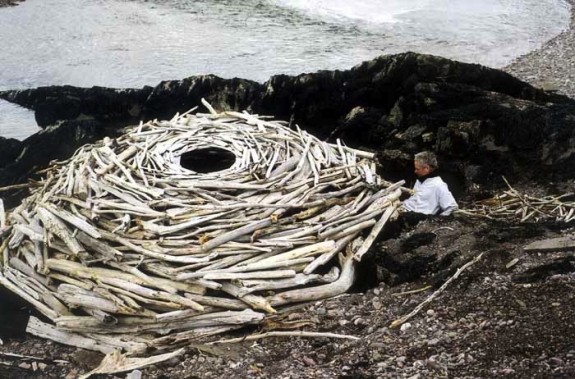
Andy Goldsworthy is a photographer, sculptor and environmentalist. He uses nature and what it gives him to make his creations. I love how he uses the environment and the area around the sculpture as part of his finished piece. 'Woven branch' is an example of this.

Andy Goldwworthy Woven Branch Circular Arch, Dumfrieshire, 1986
I like how Andy Goldsworthy takes one photograph of his sculptures and then allows them to be destroyed by nature over time.

Andy Goldsworthy a scene from Rivers and Tides

Erwin Wurm


Erwin Wurm's main medium is sculpture although his work is usually documented through photography.  Wurm thinks of his sculptures as an act rather then a static object. I was intrigued by his series of work 'One minute sculptures' which are playful, slapstick and bizarre performances which Wurm has instructed. I liked how his sculptures are awkward, some quite graphic but still comical and amusing giving the viewer a mixture of emotions and feelings towards his work. I also like how from the instructions Wurm leaves, everyone interprets them differently, not just making one sculpture but a range of different interpretations.

One minute sculptures - Erwin Wurm

Irwin-wurm-one-minute-sculptures-6
One minute sculptures - Erwin Wurm


Irwin-wurm-6
One minute sculptures - Erwin Wurm

Thursday, 12 September 2013

Tony Cragg


Tony Cragg is a sculptor, he creates large scale, carefully curated installations made up of found materials from household rubbish, such as toothbrushes and metal washers. They are then painted in bright colours and laid out to create graphic forms. I like how Cragg's work looks like graphic forms & silhouettes from far away, yet up close they are intricate and detailed. He transforms what was once meaningless rubbish that someone has thrown away into beautiful, brightly coloured works of art.


Palette - Tony Cragg 
I like how in 'Palette' He has painted every object in different colour unlike a lot of his other pieces which are just different shades of one colour. He has carried the same colours throughout but has mixed them up. This represents a real artists palette - bright colours intertwined with each other. 
'Britain seen from the north'

The Streets Are Full of Cowboys (1981)

Monday, 9 September 2013

Susan Hiller

Susan Hiller is an installation artist. I Like how she uses audio in her pieces to give them more intimacy. 'monument 1980' which was exhibited at Tate britain, consists of 41 coloured photographs of Londoners who died trying to rescue others which are lay out in a diamond shape behind a park bench.  On the park bench are headphones in which you can listen to the artists meditation of death and heroism etc. This makes the viewers participants in the work. I like how the use of audio in Susan's work gets the viewers more involved in her pieces and the words give the photographs more meaning.
Monument (1980)


 Witness (2000) 

Cornelia Parker

Cornelia Parker is an English sculptor and installation artist. I like how she transforms such normal and recognisable objects into abstract works of art. I was especially intrigued by 'Cold Dark Matter: An Exploded View.' At a first glance this installation just looks like abstract explosion of wood, until your eyes piece it together and you see that it is in fact a shed. I like how the light placed inside the shed casts shadows on the walls, this gives it the effect that an explosion is actually taking place.

Image of: Cold Dark Matter: An Exploded View


  •                        Cold Dark Matter: An Exploded View, 1991